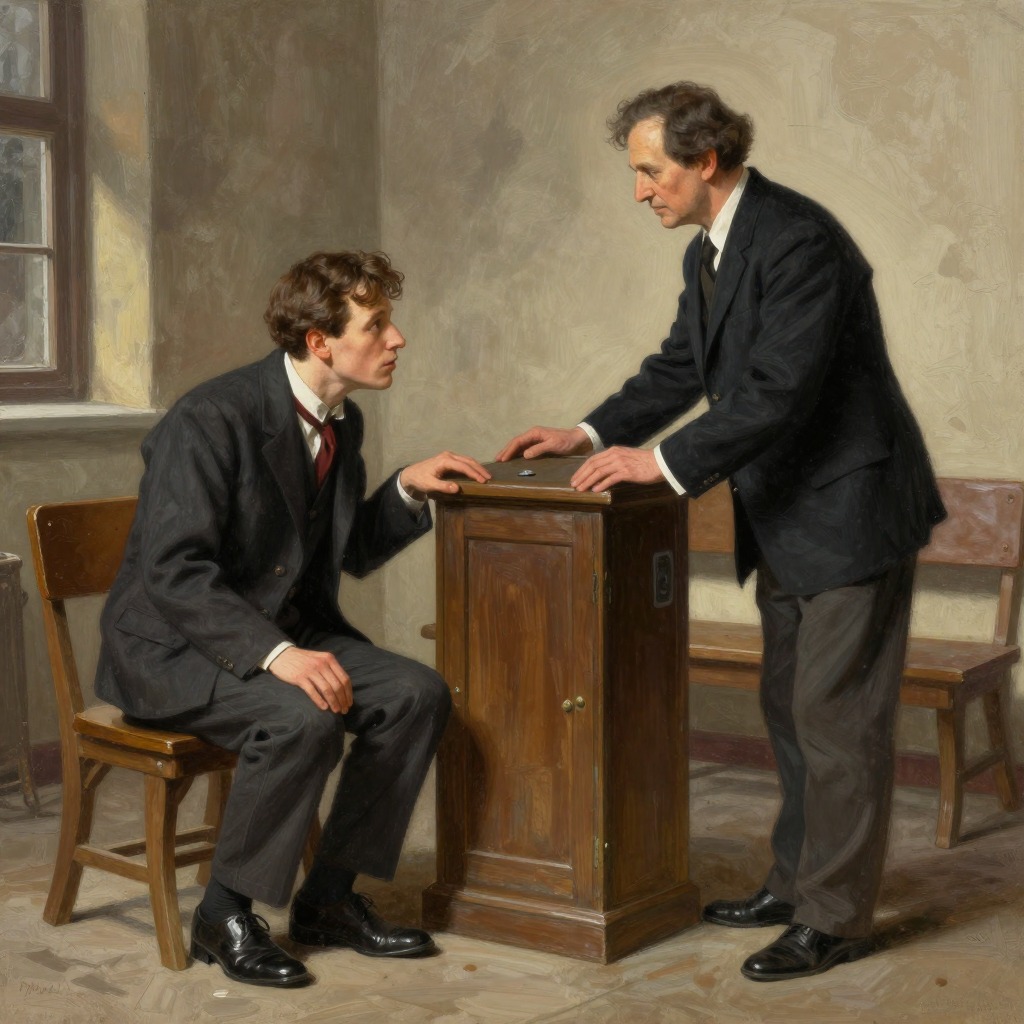
The woodshed
The woodshed at the school is a small, locked outbuilding that becomes a flashpoint of conflict between K. and the teacher, symbolizing the petty authority and material deprivation that define K.'s life as school janitor. Its forced entry by K. and Frieda, and the subsequent confrontation, reveal the precariousness of their position and the constant struggle for basic necessities in the village.
Location and Significance
The woodshed is an outbuilding of the school, a long, low building that K. first sees on his initial walk through the village, standing in a fenced garden covered with snow. It is a place of basic necessity, holding the firewood needed to heat the school's classrooms. Its significance lies not in its physical description—which is never given in detail—but in its function as a controlled resource. The teacher holds the key to the woodshed, and he permits firewood to be taken only during school hours. This rule transforms the woodshed from a mere storage space into an instrument of authority, a means by which the teacher can exert power over K. and Frieda, who are left freezing in the schoolhouse without fuel.
The Forced Entry
On their first night in the school, K. and Frieda find the room cold, with the stove having consumed all the wood. The shed is locked, and the teacher has the key. Faced with the prospect of an unbearable night, K. decides to break in. He looks for an axe, which the assistants find, and they go out to the woodshed. Its flimsy door is soon broken down, and the assistants, delighted as if they had never known such fun, begin carrying wood into the classroom, chasing and pushing each other about. This act of transgression is a direct challenge to the teacher's authority, and it sets the stage for the morning's confrontation.
The Confrontation and Its Aftermath
The next morning, the teacher catches the assistants fetching firewood and drags them into the classroom, demanding to know who broke into the woodshed. Frieda, in a display of loyalty and quick thinking, claims responsibility, saying she broke down the door with the axe herself because she dared not come to the teacher for the key at night. The assistants, however, point to K., and the teacher turns his fury on him, calling him a coward for letting others take the blame. The teacher dismisses K. from his post as school janitor on the spot, though K. refuses to accept the dismissal, insisting that only the village mayor, who appointed him, can remove him. The confrontation ends with the teacher and Miss Gisa moving the children to the other classroom, leaving K. and Frieda alone in the room. The woodshed incident thus becomes the catalyst for K.'s open defiance of the teacher and his assertion of his rights, however precarious they may be.
Symbolic Resonance
The woodshed embodies the theme of exclusion and the struggle for basic survival that pervades K.'s experience in the village. It is a locked door, a barrier to warmth and comfort, controlled by a petty official who uses it to assert his dominance. K.'s breaking of the door is not just an act of desperation but a symbolic rebellion against the arbitrary rules that govern his life. The wood itself, once obtained, provides only temporary relief, as the room becomes too hot and the supply is quickly exhausted. The woodshed, like the castle itself, represents a resource that is both essential and inaccessible, a constant reminder of K.'s lowly status and his dependence on the goodwill of others. Its role in the narrative highlights the absurdity and hardship of his position, and the lengths to which he must go to secure even the most basic comforts.